
yes
Digital twins and Physical AI systems depend upon reliable information from the physical environments they represent, analyse and interact with.
Sensors provide the connection between physical assets and their digital representations. Cameras, LiDAR, inertial measurement units and other sensing technologies acquire information that can be used to update digital models, support simulation, guide autonomous decisions and monitor operating conditions.
However, the quality of this information can be affected before it reaches the digital system.
Mechanical vibration, structural movement and changing operating conditions can introduce disturbances into sensor measurements, potentially affecting the accuracy, consistency and usefulness of the acquired data.
Graphibre is investigating vibration isolation at this critical physical–digital interface.
By combining responsive materials, engineered mechanical structures and lightweight composite construction, Graphibre aims to develop an isolation architecture that could support more consistent physical data acquisition in demanding operating environments.
The technology is intended to complement existing sensor stabilisation, signal processing and digital modelling techniques rather than replace them.
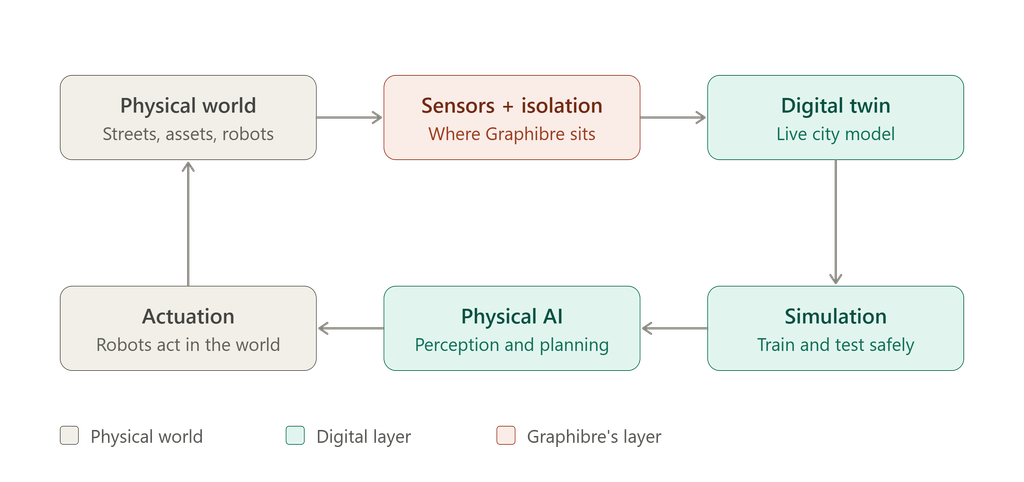
Digital twins and Physical AI can form part of a continuous feedback process connecting real-world equipment with digital models and intelligent control systems.
A representative architecture comprises six interconnected elements:
1. Physical World
Industrial assets, infrastructure, autonomous platforms, robotics and other physical systems operate within changing mechanical and environmental conditions.
2. Sensors and Physical Isolation
Cameras, LiDAR, inertial sensors and other measurement devices acquire information about the physical system.
Graphibre’s proposed role is at this interface, where vibration isolation may help manage mechanical disturbances affecting sensor measurements.
3. Digital Twin
Sensor measurements can update a digital representation of an asset, process or environment, allowing its condition and behaviour to be monitored and analysed.
4. Simulation and Analysis
Digital models can support simulation, scenario evaluation, performance analysis and the investigation of possible system responses.
5. Physical AI
AI-enabled systems may use physical measurements, digital representations and simulation outputs to support perception, prediction, planning and control.
6. Actuation and Feedback
Control decisions can influence the physical system through actuators, machinery or autonomous equipment.
The resulting physical changes are measured again, creating a continuing feedback loop.
Graphibre is not the digital twin, simulation environment or AI decision-making system.
Its proposed contribution is the physical isolation layer associated with sensing equipment, where mechanical disturbances can influence measurement quality before data enters downstream digital systems.
The potential value of this approach will depend upon demonstrating that improvements in mechanical isolation translate into meaningful benefits for the relevant sensors and applications.
Industrial digital twins can use sensor measurements to monitor equipment, analyse operating conditions and support maintenance and operational decisions.
Graphibre could be investigated for vibration-sensitive sensors installed on industrial machinery, production equipment and monitoring systems.
Digital representations of buildings, infrastructure and urban environments may incorporate data from distributed sensing networks.
Potential opportunities include precision measurement systems exposed to mechanical disturbances, particularly where consistent data acquisition is important for monitoring or modelling.
Robots and autonomous platforms rely on sensor measurements to perceive their surroundings, estimate movement and interact with physical environments.
Graphibre could be evaluated as a compact isolation component for selected sensing assemblies operating under changing vibration conditions.
UAVs equipped with cameras, LiDAR and other sensors can acquire information for mapping, inspection and the development or updating of digital representations of physical environments.
Graphibre’s proposed lightweight isolation architecture may offer opportunities for integration into airborne sensing payloads, subject to application-specific validation.
Beyond supporting external digital-twin applications, Graphibre is investigating a longer-term research opportunity: developing a digital representation of its own isolation system.
This would involve using physical measurements to characterise and model the relationship between operating conditions, material behaviour and mechanical response.
Potential measurement inputs include vibration, temperature, displacement and selected electrical characteristics of the responsive material system.
By correlating these measurements, a digital model could potentially support:
This represents a prospective research direction rather than an existing validated capability.
The development of a useful digital model will require experimental characterisation, appropriate sensing methods, reliable data acquisition and validation against measured physical behaviour.
Graphibre’s initial experimental programme will focus on the physical behaviour of its proposed isolation architecture.
Comparative testing will examine vibration transmission and other relevant mechanical characteristics under controlled operating conditions.
Subsequent application-specific evaluation may investigate the relationship between isolation performance and downstream sensor measurements.
For digital-twin and Physical AI applications, relevant questions include:
The objective is to establish an evidence-based assessment of where Graphibre could provide technical value within physical–digital systems.
The increasing use of digital twins, autonomous systems and AI-enabled industrial equipment creates potential demand for technologies that support reliable physical data acquisition.
Graphibre’s prospective commercial role is as a specialist enabling component within larger sensing and control architectures.
Potential partners include sensor manufacturers, robotics developers, industrial equipment suppliers, systems integrators and organisations developing digital-twin applications.
International programmes involving industrial digitalisation, smart infrastructure and autonomous systems may provide additional opportunities for technical evaluation and commercial partnerships.
Graphibre intends to assess these opportunities according to identifiable customer requirements, experimental evidence, integration feasibility and commercial viability.
Graphibre welcomes discussions with research organisations, digital-twin developers, sensor manufacturers and industrial partners interested in investigating the relationship between mechanical isolation and physical data quality.
Potential collaboration activities include sensor integration, comparative testing, physical-system modelling, application-specific demonstrations and longer-term adaptive-control research.
For technical collaboration or development enquiries, contact info@graphibre.com.